Tenouchi and the Path to Freedom
By Nelson Pecora
When manipulating the sword, the interface between the tsuka and hands is of utmost importance. Not only is this the critical juncture where power is transferred between the body and the blade, but it’s also a conduit for information: pressure, proprioception, and other sensitive signals travel from the sword back to the body.
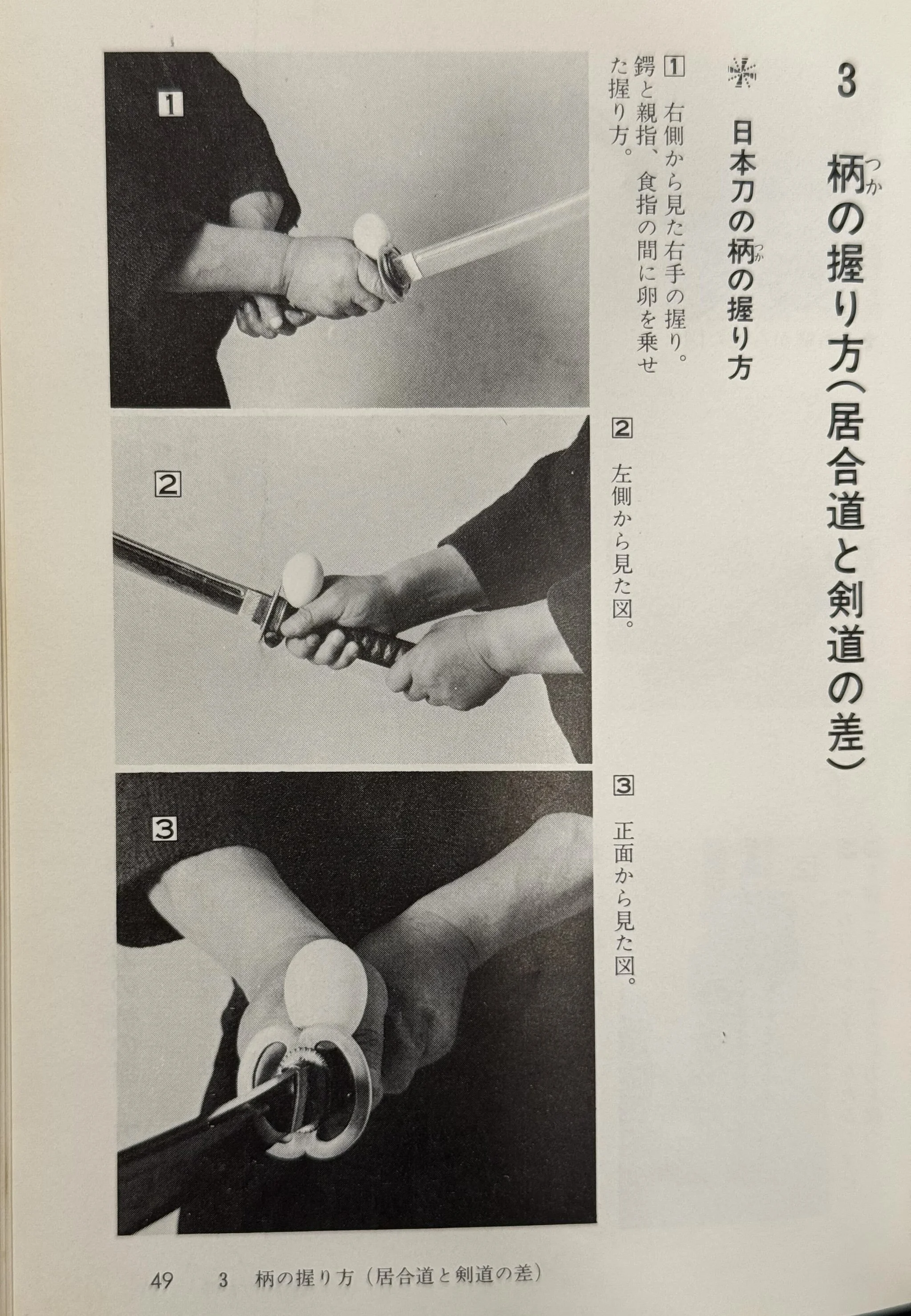
When discussing this interface, we generally use two terms: tsukanigiri (柄握り) and tenouchi (手の内). The first term simply translates to the “grip on the tsuka,” and we use it to refer overall to how one places their hands on the tsuka. This encompasses everything from the location of the hands, the angle (kiri-te) of the wrists, the lateral rotation that provides stability and structure behind a cut, and the amount of pressure in the grip when the sword is at rest.
Tsukanigiri is the scaffolding upon which every kamae and cut rests. If there are issues with this structure, a student of the sword cannot progress beyond the basics. Improper location will force them to use incorrect muscles during a cut. Improper kiri-te will leak energy and not allow the sword to return to the body at the end of cuts, hampering transitions to the next movement. Poor rotation, where the heels of the hands are not behind the tsuka, will lead to either weak cutting action or, in worst cases, dangerous situations where the sword may not be able to be stopped at all, or may fly out of the hands when it impacts a target.
Maintaining proper tsukanigiri by itself will not lead to perfect swordsmanship, however. Both cuts and strong kamae require specific micromovements and dynamic pressure in the grip, which we usually call tenouchi. Literally “inside the hand,” this term reflects many of the more specific and technical aspects of gripping the sword and how that grip changes actively over the course of a cut.
A common metaphor used to explain tenouchi is holding an egg. A static, tight grip will crack the egg, but a loose, mindless grip will let the egg slip out of the hand. Instead of either, a practitioner needs to maintain an active presence in their hands: Firm but not clenched, alive but not excited. This isn’t just for kamae; during a cut one must actively modulate grip pressure (through the use of micromovements in their fingers and wrists) to maintain this firm but calm connection to the sword, which allows energy to flow outwards and information to flow back to the body.
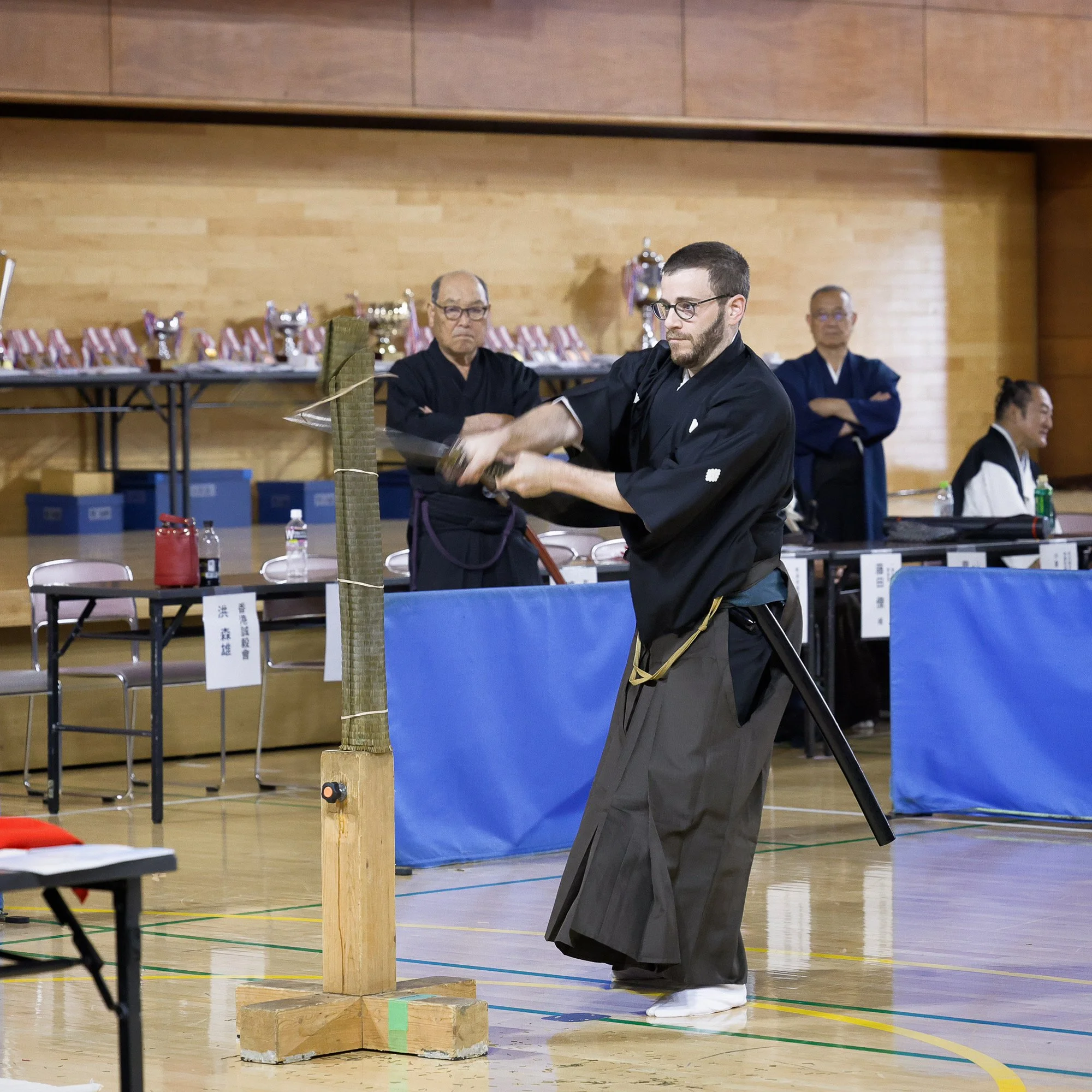
There is a second meaning to tenouchi that’s worth considering: In modern, colloquial Japanese, tenouchi wo miseru (手の内を見せる) is a common phrase that’s roughly equivalent to the English idiom “showing your hand.” Tenouchi, the “inside of the hand,” is a metaphor for a hand of cards or a closely held secret. To show one’s hand prematurely is to lose the advantage, to reveal your strategy, to lose the initiative.
This is especially relevant in Nakamura Ryu kata. The subtle movements at the start of each kata, and even the particular way we practice nukiuchi, are geared towards hiding the initial attack (and even the angle of the first cut) until the very last moment. The ability to begin an engagement and launch an attack with minimal tells is, in a direct sense, keeping your tenouchi hidden.
One of the ways we achieve this is by emphasizing metsuke (目付). When “acquiring targets,” one’s gaze should be controlled and deliberate rather than wild and conspicuous. We frequently tell students that the sequence of a cut, which is the sequence of a larger kata, “begins with the eyes, then involves the body, then finally the sword.”
Many terms we use in budo have, over centuries, become idiomatic expressions in everyday Japanese. Tsubazeriai, for example, is the equivalent of the phrase “neck and neck.” But certain terms – metsuke and zanshin in particular – have not made this journey. When we talk about metsuke, we don’t just mean “looking at something.” Instead, we’re describing something qualitatively different from a normal gaze or glance. We’re describing a conscious visual commitment: The eyes settle on a target with an intentionality that organizes the rest of the body in response. This is more akin to target acquisition, and it prepares both the mind and body to engage with a target properly.
The sequence that I described above – in which the eyes lead, the tanden engages, and the sword moves last – is a key aspect of swordsmanship that requires years to master. Frequently you’ll see beginner students doing this sequence in reverse. When the sword moves before the eyes have settled, there’s a large probability that the practitioner is simply going through the motions of the technique rather than performing the kata with intention.
Similarly, the distance and timing between targets separates those who are going through the motions from people who are telling the story of the kata. While kumitachi, gekken, and other exercises give students the benefit of a real opponent, solo kata requires them to imagine (and demonstrate that they’re imagining) one or more invisible targets. Experienced practitioners can see the difference between a student cutting the air and one who is truly embodying a scenario and expressing the meaning of a kata. When we discuss distance and timing, we use the terms maai (間合い) and ma (間). The words themselves share the same root kanji, aida (間), meaning interval or gap. This character can describe physical space, elapsed time, or even conceptual distance: The gap between ideas, the pause between notes in music, the “magic circle” in games where the rules of the outside world are replaced by a shared conceptual structure between players.
The ai (合い) in maai is the same auxiliary verb found in words like miai (seeing each other) or tachiai (face off). It suggests a reciprocal or reflexive action between two parties. Thus, while either maai or ma can be used to refer to distance or timing, their connotative meaning in the context of budo has crystallized into two separate ideas. Maai has come to mean the physical distance between opponents, whereas ma refers to the timing and rhythm within one’s own body.
As Einstein demonstrated, space and time are not independent. Instead, they’re interrelated ideas that affect each other. This is also true in budo. To close distance is to compress the amount of time either party has to act, and to hold distance is to preserve one’s own time to respond.
Among the many frameworks for understanding maai and ma, one that I find most illuminating comes from kendo: The tripartite distinction between go no sen (後の先), sen no sen (先の先), and sensen no sen (先々の先). Go no sen, “initiative after,” describes the response after an opponent has already acted. It’s purely reactive, defensive, coming-from-behind. This type of scenario occurs very often, and a practitioner who is calm and focused is able to react appropriately to parry or turn around an attack.
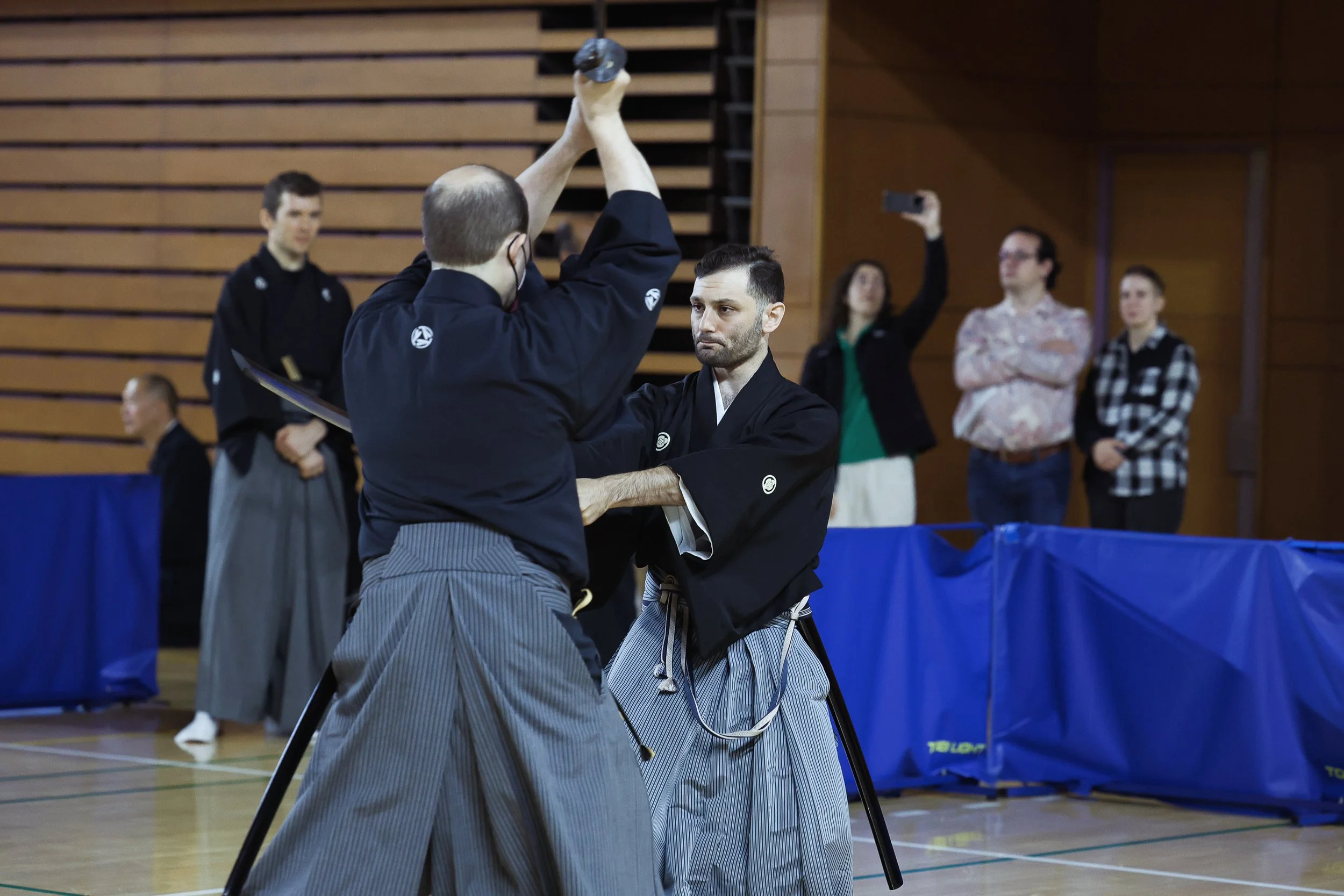
Sen no sen, “initiative within initiative,” is the next level of response. This happens when one perceives an opponent’s intention before their technique has started, allowing one to initiate an action into that gap. This requires a higher level of perceptual acuity and a willingness to commit before the danger has fully materialized, but allows a practitioner to take brief control of both timing and distance.
Sensen no sen is the most demanding level of response, and isn’t really a “response” at all. It describes not merely anticipating an opponent, but rather imposing oneself into the opponent’s decision-making loop directly. The practitioner fully controls timing and distance in a way that shapes the frame by which their opponent evaluates options and makes decisions. By controlling which options their opponent perceives as available, they create a situation where only one (or a limited number) of moves seem viable, and all of those moves are beneficial for them.
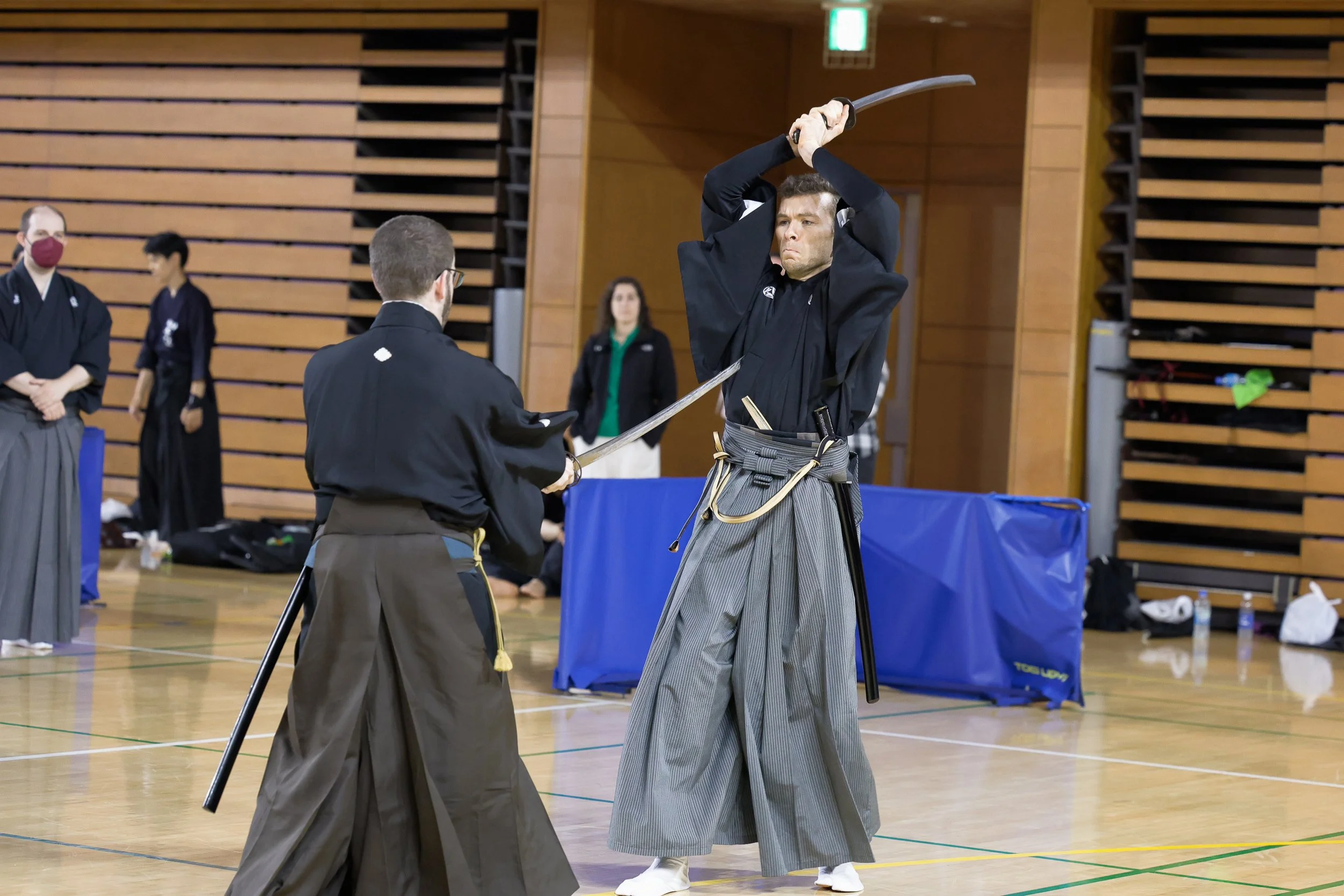
These three types of responses are not just tactics; they also represent stages of development. Beginner students operate mostly in go no sen, they respond to what they see. Over time, students develop the sensitivity and mindset to start exploring sen no sen and eventually sensen no sen. To develop this mindset, they must bridge the gap between thinking about maai and ma and truly feeling them on an unconscious level.
This development is reflected in both the macro level of kata and the micro level of a practitioner’s connection with the sword. One could argue that the entire pursuit of modern budo is one of developing sensitivity, both to one’s own body and to the relationship between oneself and others in time and space. From the way we hold the sword, to the way we connect our eyes and intention with others, to the way that shifts and evolves over the course of an engagement, we must move beyond an intellectual understanding of these principles and fully internalize them in our subconscious and muscle memory. When we achieve this, the act of drawing, cutting, and parrying stop being discrete actions and instead blend into one holistic framework where we can embody the highest principles of budo, jiyu jizai (自由自在), being “freely free.”
