Practice Makes Permanent
By Anthony Deen & Michael Shane
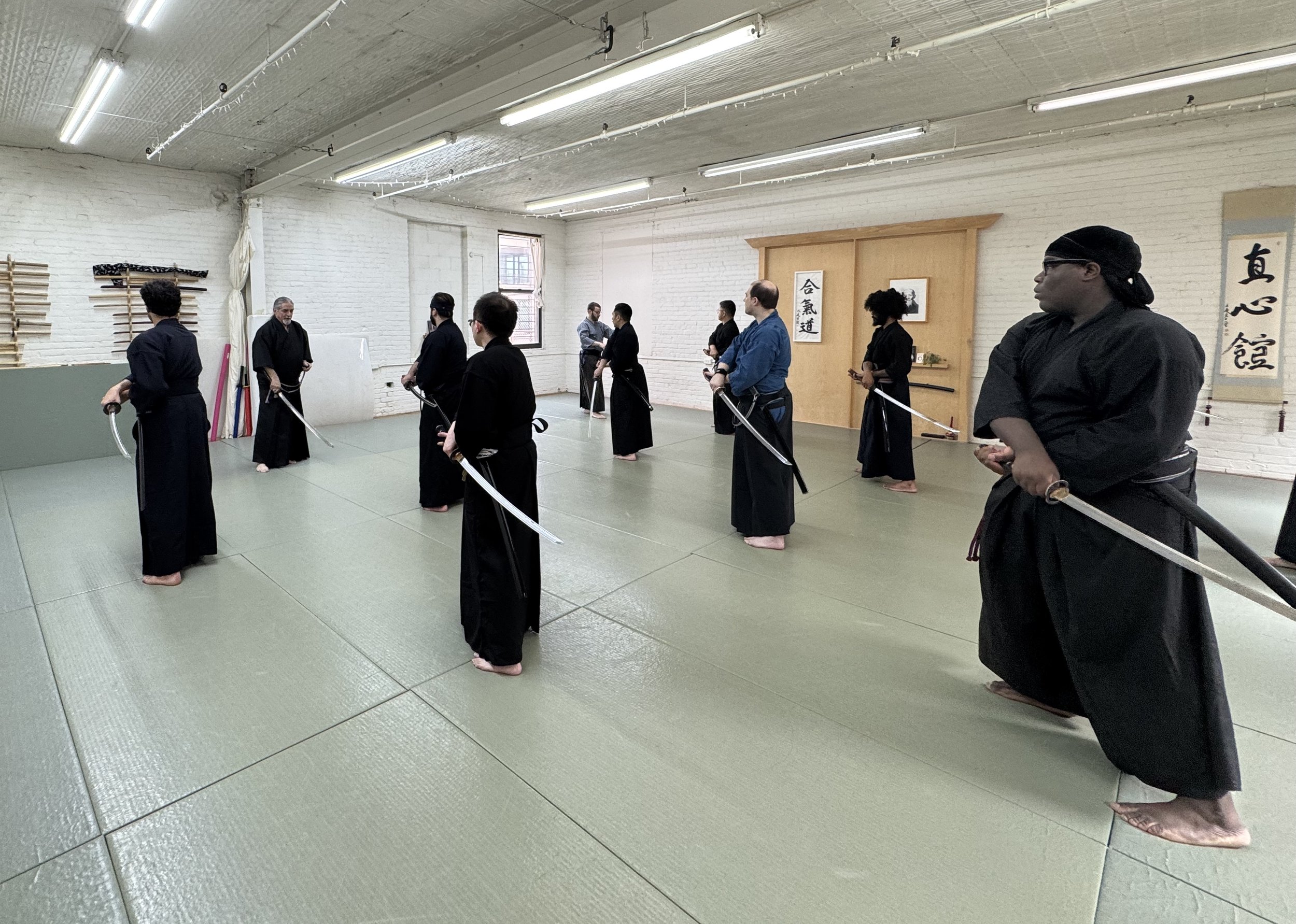
Budo in general and swordsmanship in particular are mind-body disciplines. This is to say that they engage the body and the mind concomitantly and that this engagement is not just parallel but deeply interdependent. Once these connections have been built they require regular attention and maintenance of one kind or another depending upon one’s stage in training and in life.
All arts or skills that require melding great physical dexterity with finely tuned participation of the mind – playing a musical instrument, sleight of hand, speaking a foreign language – share one thing: the requirement for practice.
We’ve recently written articles on the benefits of regular training and quoted several masters on what can be achieved through practice. But what happens when training is inconsistent or when long breaks in practice occur? If you’re serious about this art, read on, because it’s important to understand what your goals will require.
“On the first day of training, sword and human meet as alien objects; over time they become one living thing. Eventually, the blade will magnify and project the actions of the body, reflect mood and mindset, and ultimately point the way to the core of being.”
Many students practice diligently when they first begin, while the intoxicating feeling of improvement is both regularly apparent and physically palpable. Dopamine is a heck of a drug, after all. Other students are motivated by setting a tangible goal for themselves (often earning their shodan) and after reaching that milestone, they likewise allow their training to lapse. As the novelty disappears and training begins to seem repetitious, they allow other activities or life’s distractions to overtake their training regimen. These students never come to understand that true progress lies in ceaseless (but never thoughtless) repetition.
Our bodies and minds continually search for the path of least resistance, while our learned physical habits and patterns of thought constantly work to tear down anything new we might try to build in order to replace it with what is comfortable and familiar. Only through training day in and day out, with proper guidance and attention, can the collaboration of mind and body change in a durable way. Especially for students in the early years of their training, this process is tenuous. Like a small error in navigation at the beginning of a long journey, by the time you think you’ve arrived at your destination, you are tragically and irrecoverably off course. Only regular engagement with the art can provide the feedback one needs to keep the compass pointed toward the right heading. Without it, progress will be slow, static, or deleterious.
Granted, life often gets in the way of our plans – and life should always come first! – but mastery of the sword and access to the deeper benefits of this training don’t manifest at the shodan level. Shodan (初段) in fact literally means “beginning level,” and attainment of this rank means only that one has grasped the most basic aspects of swordsmanship and that the body is now prepared to play a productive role in deeper training. Attainment at any level also isn’t a permanent, binary transformation that turns you into something (or someone) new. Sword practice is like any other nutrient: without taking it on a regular basis, its benefits start to decay and eventually disappear.
「心正しければすなわち筆正しい。」
(Kokoro tadashikereba sunawachi fude tadashi.)
“If the mind is correct, the brush will be correct.”
What happens when you don’t continually practice two or more times a week? For students who’ve been training for a while they’ll find that they quickly plateau and their newfound abilities dull. At best they are capable of reproducing general physical movements that approximate the shapes of swordsmanship. At a minimum, they stop improving. While still able to memorize things intellectually, they aren’t internalizing the lessons into their bodies. Not only does muscle memory not develop further, unfortunately, it actually atrophies, as does the ability to perceive and discern. Foundational capabilities in the body, at the core, drift away. The mind dulls, and the body reverts to an uninformed state. Students find themselves unable to do things they might have once taken for granted (shizan, for example). The brain knows what they want to do but it can’t help, as the body no longer remembers how to do it.
“Those who study swordsmanship must not get caught up with concepts of good-bad-victory-defeat during the initial years of practice.… Have no confused thoughts or doubts, do not distort the techniques: without delay, train harder and harder!”
For beginners who don’t practice regularly, it’s worse because the training is systematic and incremental. Our vast curriculum progressively builds capability in the student over the years, not through the memorization of hundreds of kata, but through authentic internalization of psychophysical activities. For beginners whose bodies never learn the foundational lessons, while they may intellectually be adding information, their ability to enact what is happening inside and out of the body is nonexistent, and true capability never develops.
Like other martial arts, progress in battodo is based on steady practice and an attentive mind. We recommend training at the dojo at least twice a week, but if you want to progress, three times a week (with tanren practice at home) should be your goal. Once you’re no longer a beginner, every practice session doesn’t necessarily have to take place in the dojo, but it does have to happen. The benefit of training in the dojo is both having an instructor to guide you and experiencing the full gamut of activities that are reviewed in any given week – kihon, kata, kumitachi, kenjutsu drills, and tameshigiri, among other elements of our curriculum.
Fortunately, as long as you have an interest and a passion for Japanese sword arts there’s a simple (but not effortless) solution: “practice makes permanent.” Budo does not discriminate.
The simplest and most important step on the path remains the same for everyone: showing up.
